The first ERP in the Philippines you can just ask.
The whole system, built in Cebu — and you can ask it anything about your business, in plain English, from your own records.
Which branch made money last month?
Most companies cannot answer that until the middle of the next one. Sales are in one system, stock in another, payroll in a third, and somebody keys all of it into a spreadsheet to make them agree. Every time a number is copied it can go wrong — and by the time the report is ready, the month it describes is over.
On DBS One it is all one system, so you can ask this morning.
Every one of these is a full ERP.
What changes between them is the three things the system does that nobody else in your trade has to think about.
Restaurant groups
For groups running several brands, several branches and a kitchen that feeds them all.
Multi-outlet, a commissary, and food cost you can proveRestaurants & rooms
For a restaurant group that also has keys — the combination almost nothing else handles.
F&B and a property on one set of booksHotels & resorts
For properties where occupancy is not the same thing as profit.
Rooms, channels, outlets and eventsDistribution & trading
For importers and traders who sell the same case at four prices.
Landed cost, price levels, credit and collectionsRetail chains
For multi-branch retailers whose best and worst store look identical on paper.
Tills, shelves, shrink and margin by branchPharmacy chains
For drugstore chains carrying expiry risk and statutory discounts at the same time.
Batches, expiry, and the discounts you must giveManufacturing & food
For producers who know the standard cost and not the actual one.
Bills of material, yield, traceability and recallMeat shops & cutting
For meatshops and cutting floors where the DA sets what you may charge, so margin can only come from the break.
The price is capped. The yield is yours.Auto supply & service
For auto supply with a talyer attached — four grades of one part, and hours no parts system has held.
A counter, a bay, and one job card across bothAny Philippine business
For a company that has outgrown the arrangement holding it together.
Four systems and a spreadsheet, replaced by oneNo other ERP sold here can do this.
Ask in plain English and you get the figure, the tools it reached for, and the records it read — and two of the questions below, it refuses. Every vendor has AI this year; the one worth having is the one that will tell you when it does not hold the rows.
Which outlets are losing money?
It reads rows and reports them. It never does the arithmetic itself.
It answers
Ask in plain English and get the figure, how it got there, and the records it came from. No report writer, no consultant, no waiting.
It stays out of your records
Of 258 tools it can reach, three can write — and none of them touch your ledger, your stock or your payroll. It proposes a setting change, remembers a word your business uses, or raises a ticket when it is beaten. A person approves; the decision is recorded with who and when.
It teaches
Every screen, every step, every permission. A new supervisor asks it how, and is productive on their first shift instead of their third week.
Six people. One assistant. Six different answers.
Everyone else gives the assistant a service account that sees the whole company, then writes a prompt asking it to behave. Ours runs as you, through the same row-level security as the screens — so a cashier asking for the payroll register does not get a polite refusal. They get no rows.
One assistant. The database refuses the rest.
Your staff do not work in English.
The assistant reads Cebuano, Bisaya and Tagalog alongside English, and it is built to survive how people actually type — no diacritics, phone keyboards, Taglish halfway through a sentence, and a word spelled three ways in one shift. A supervisor in Danao asks the way a supervisor in Danao talks.
“Pila ang halin karon?”
How much have we sold today. Cebuano, and it answers from the till, not from a phrasebook — the question is understood, then it reaches for the same tool your controller’s English question would reach for.
“Magkano ang VAT namin?”
How much VAT do we owe. Tagalog, and the figure comes out of the same return the accountant files, not a second calculation that can drift away from it.
“pila ang stock sa bodiga”
Misspelt, unpunctuated, no accents, and still right. Spelling tolerance is measured against the word it meant, not against a dictionary — because a shift supervisor typing one-handed is the normal case here, not the edge case.
The reason to trust what it does.
Every AI page lists what theirs can answer. None of them say what happens when it does not hold the rows, because for most of them the honest answer is that it makes something up.
It will not invent a figure
Ask for a number the records do not support and it says so, and says what it would need. Every figure it does give comes from a view or a function — the model explains arithmetic, it never performs it.
“There is no cost on file for 1,827 of these lines. I have counted them as nothing rather than estimate them, so treat this total as a minimum.”
It will not show you somebody else’s rows
It runs as the person asking, through the same row-level security as the screens. A purchasing manager asking for payroll gets nothing back — not a polite refusal written into a prompt, but no rows at all.
“Payroll is behind payroll.view and this session does not hold it. Your controller asking the same question gets the register.”
It will not change anything on its own
Three of its 258 tools can write, and not one of them changes your records or your settings. Two draft a proposal for a person to approve — the correction, the setting change. The third raises a ticket when it cannot answer you, signed as the assistant so nobody mistakes it for a colleague.
“Your reorder point for pork belly looks low against the last sixty days. I have written the change down for you to approve on the settings screen — I have not applied it.”
You will have used it before you buy it.
Every other vendor asks you to picture your business running on their software. That is a great deal to take on trust for a decision this size — so we build it first, and give you the keys.
How it usually goes
You watch a demo of a sample company that is not yours. You sign. Then the real work starts — weeks of explaining your business to consultants who have never seen it, while your staff learn a system they have barely touched and still have a company to run. You find out whether it fits after you have paid for it.
How this goes
We sit with you first — your departments, your workflows, your paperwork, what actually hurts. We build DBS One around it and switch on the modules you asked for. Then you get logins: your people, your roles, your company already in it. You decide afterwards, knowing.
Why nobody offers this
Because it costs us weeks of work on businesses that may never sign. A vendor selling to a quarterly quota, through a partner who is paid on the contract, cannot afford to. We can — because we would rather lose the deal early than lose a year of yours.
The proposal you get from anyone else is not the whole bill.
Every vendor names the license and the implementation. Almost none of them name the seats as you hire, the changes after go-live, or the maintenance on the license. Choose the business closest to yours.
around 120 staff, one distribution center
Roughly ₱11.0M kept in the business over three years — and the gap widens every year after that, because their license renews and ours does not exist.
Year one, line by line9 rows
| What you are billed for | A typical ERP | DBS One |
|---|---|---|
| Software license, year one | ₱2.5M to ₱5.0M | None. There is no license. |
| User seats | Per person, per year, forever | Unlimited. Every person, no charge. |
| Implementation partner | ₱1.5M to ₱4.0M, billed by the day | In the implementation fee, by us |
| Philippine tax & BIR | ₱300k to ₱800k, an add-on module | Built in. It is the shape of the system. |
| Servers, backup, recovery | ₱250k to ₱600k, plus somebody to run them | Included and hosted |
| Training | ₱150k to ₱400k, per session, per person | Included — and the assistant teaches |
| Changes after go-live | ₱400k to ₱1.5M in year one alone | Included in maintenance |
| Annual maintenance | 18–22% of the license, every year | One monthly fee, that is all |
| Version upgrades | A project, every few years | Continuous. You are always current. |
Ranges are what Philippine companies of this size are quoted. Ask any vendor to fill in the middle column themselves — in writing, for three years, with seats at your expected headcount. The exercise is short and it is usually decisive.
There is not a row on this page we lose.
| What | A typical ERP | DBS One |
|---|---|---|
| Time to live | 6 to 18 months, often longer | 30 days, written into the contract |
| Users | Priced per seat, per year | Unlimited, included |
| Annual license | ₱2.5M to ₱5M a year, forever | None. There is no license. |
| A small change | Quoted, scoped, scheduled | Same day to 48 hours, included |
| A new feature | A change order with a price | Included in maintenance |
| Philippine tax & BIR | An add-on, maintained by a third party | Built in, updated centrally |
| Your trade | A vertical add-on bought separately | Native, and built first |
| Your paper documents | Keyed in by your staff, forever | Read, checked and posted |
| Integration | Only where an API already exists | Anything — and paper where there is none |
| AI | A chatbot reading a help page | Built in, on your own ledger |
| The technology | Often a decade old underneath | Current, and continuously updated |
| Support | A reseller and a ticket queue | The people who wrote it |
| Upgrades | A project, every few years | Continuous, and free |
| Where it was built | Abroad, localized afterwards | Cebu, for Philippine trade |
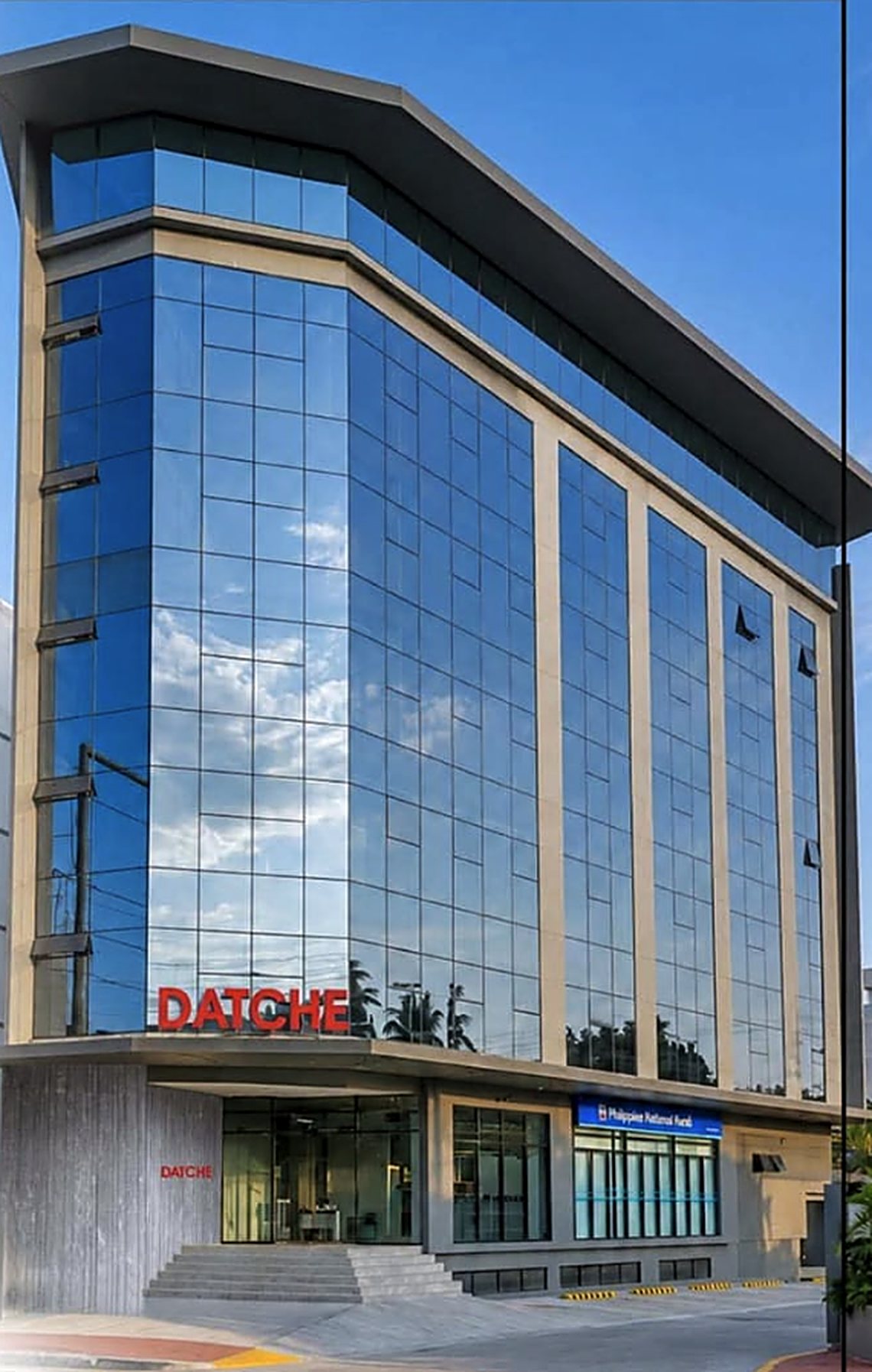
A Cebu company, trading since 1978.
New Datche Philippines Traders Corporation has served Philippine businesses for forty-eight years. We wrote every line of DBS One ourselves, we host it, and we answer the phone about it — no reseller, no offshore partner, nobody to escalate to. Walk in and meet the people who would run your implementation.
Thirty days, and the date is in the contract.
Not a twelve-month program, and not a pilot. Four weeks, with the date written into the contract — and you see your own documents running in week two.
- 01
Your chart, your companies, your locations
We load your accounts, entities, branches, suppliers and items, and connect to the systems and devices you already run.
- 02
Opening balances and one day of paper
Balances in, and a real day of your own documents run through capture in front of you.
- 03
Your people, on the system
Roles, approvals and training — with the assistant answering “how do I…” from day one.
- 04
Live, with us in the room
You trade on it. We are on site and on call, and the first close happens with our team beside yours.
See it run on your own numbers.
Bring one day of whatever your business produces — invoices, a Z-reading, a payroll register. We will run it through in front of you and you keep whatever comes out the other side. About an hour, and no obligation.